Tuesday, December 31, 2013

Sunday, December 1, 2013
For Poets and Lovers of Poetry
 Poets Translate Poets: A Hudson Review Anthology by Mark Jarman
My rating: 4 of 5 stars
(I was provided an electronic galley of this book through Netgalley and the publisher.)
So good, I'm buying a copy! A must-read for anyone interested in world poetry and the art of translation. Only missing the original-language verses for comparison. I'm sure most people don't speak every language, but it's one of the joys of reading translations; when one does know both languages, it's easier to see both poet's visions--that's the theme of this collection, if nothing else is--a poem, translated, is two poems. Does one go literal or does one translate for spirit and image? Mark Jarman's introduction alone is a lovely treatise on this theme.
As well as an overview of world poetry both historical and contemporary, the book contains translations from the careers of several poets, Merwin for one example--you can get an overview of his poetic sensibility over time by reading his translations over time. Though an original conceit of the editors was to arrange the book by translator in order to highlight this, the poems are instead arranged by language and by time within that language. Not a comprehensive collection, but a representation of what's been published in the Hudson Review over the years. Biographical notes on the original authors and the translators place each selection in time and context.
A must-have for any student of poetry and certainly many libraries.
View all my reviews
Tuesday, November 26, 2013
How the Ancestors Lived
 Shaman by Kim Stanley Robinson
My rating: 4 of 5 stars
Kim Stanley Robinson has imagined the life of one of the artists of the Chauvet cave in France. It's a novel of history and character, and though there is adventure, danger, and romance, Robinson views it as day-to-day life and not as plot. As are most of Robinson's books, it's an exploration of utopia, but in a possible past, instead of a possible future. I still haven't finished reacting to it. Its images will stay with me for a long time, and now I'll look at the cave paintings, too. If this theme and pre-history fascinate you, too, this is a must-read.
View all my reviews
Are cats really human?
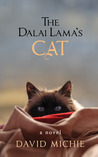
My rating: 3 of 5 stars
If you like cats, if you like Buddhism, you will like the book. Too long to be a fable or a parable, it is not a novel, but a moralistic tale told from the point of view of a cat. The Dalai Lama has gone on a long trip, and told the cat to study the art of purring while he's gone. There are some lovely moments, a love story or two, or count the whole thing as a love story, but the cat who tells the tale is more from the "trainer: tell them what you're going to tell them, tell them, and then tell you what you told them" school than the storyteller school. The point of view keeps slipping into a 21st Century, First World, human, instead of the cat. But I liked it.

Sunday, November 17, 2013
The Thousand Names deserves several thousand pages
 The Thousand Names by Django Wexler
My rating: 5 of 5 stars
A curst good book! After 513 pages, I was both blessing and cursing Django Wexler. Like David Drake, Eric Flint, and David Eddings, he can write likeable characters--a must for a series you're going to follow however long it takes. A firm grounding in history gives a realistic portrayal of the realities of military life and colonialism.
Khandar is a land steeped in all-but-forgotten magic (think Egypt, maybe). The Vordanai Empire has diplomatic relations (and a military outpost) with Khandar's ruler, a dissolute monarch. When there is an uprising of religious fundamentalists, the Vordanais must send more military aid. Marcus, the Senior Captain, will be so relieved to give over command! He is the consummate career officer, brave, honorable, and true--too loyal to his friends, sometimes. Winter is a lowly private, promoted out of spite--her Sergeant thinking she'll be sent on a suicide mission. Winter's been masquerading as a young man ever since she escaped from the orphanage. Janus is the new Commander, a man with a military gift as great as Napoleon's. He'll get the job done, but he's on the track of a magical mystery--despite the Vordanai disdain for magic as superstition.
Wexler has just the right balance of action and exposition. His society does feel like it's right in the 1700s-1800s, and Napoleonic studies certainly influenced Wexler, but I am also put in mind of Romans and Greeks, and Belisarius and Alexander in addition to Napoleon. I bought the book. I preordered book II, The Shadow Throne, coming July 2014. I posted on Facebook. I wrote a fan letter--only a few other times have I done that!
So happy, and so sad, to discover another series--to look forward, but have to wait!
View all my reviews
Sunday, November 3, 2013
Saturday, November 2, 2013
Summer of the Foodies
 Provence, 1970: M.F.K. Fisher, Julia Child, James Beard, and the Reinvention of American Taste by Luke Barr
My rating: 5 of 5 stars
Thanks to the publisher and Netgalley, I received an e-galley of the book. Thanks to Paul Barr’s beautiful storytelling, I preordered a hardcopy 20 pages into my first read.
Lovely book! It helps if you’ve an interest in American (U. S.) culinary history, French cooking, or France. Vacationing in Provence, summer 1970, were M. F. K. Fisher, Julia and Paul Child, James Beard, and cookbook editor Judith Jones and her husband. The Childs’ summer home was on the estate of Simone Beck, Julia’s co-author of Mastering the Art of French Cooking. Also living in Provence, Richard Olney, an American ex-pat who out-Frenched the French when cooking.
The author, Luke Barr, is Fisher’s great-nephew and built the book around M. F.’s journal of that summer and extensive interviews with some of the players still living—Jones, Luke’s grandmother Norah, who was there for part of the summer, and the extensive letters of all the players. He frames that summer as a turning point in American culinary history—from a French and European snobbery and sensibility to a more encompassing, original, and all-embracing philosophy of food. These important foodies and their friendships and rivalries and personal styles of cooking embraced and irritated one another in turn, forming a new foundation of American cookery, enabling the modern Food Network and the celebration of local, fresh ingredients, fusion cuisine, artisanal baking, So-Be, and everything in-between.
I loved Luke Barr’s writing. The middle of the book, based upon Fisher’s diary, painstakingly researched to make the conversations come alive through the participants’ actual letters and memories, is interesting, but the personal reminiscences of Fisher’s last California home at the beginning of the book and the summer in the Childs’ home in Provence and that celebratory last dinner with family and friends—delicious!
View all my reviews
Subscribe to:
Posts (Atom)